From Traditional to Commercial Livestock Farming
How Mr. Ripu Daimari, a graduate youth, built a diversified farm around scientific pig rearing
Introduction
Most people in Udalguri district eat meat and fish, so demand for both is high. More than 30 per cent of the district’s population belongs to Scheduled Tribes, and many families depend on animal husbandry for their livelihood. Pork is in great demand, and so are good-quality piglets, which are hard to find within the district. Commercial pig farming, both for meat and for piglet production, is therefore an attractive form of self-employment and is quickly gaining popularity.
Background and KVK Intervention
After graduating in 2012, Mr. Daimari completed a 45-day training programme in Guwahati and started a rubber plantation on 2.13 ha. He also grows tea on 0.6 ha and rice on 3.2 ha, with varieties such as Ranjit, Bahadur, Swarna, Maniram, Joha and Barni. So far he has attended five training programmes, including trainings from the Rubber Board.
In 2018, he came in contact with KVK Udalguri scientists under the Tribal Sub-Plan and showed keen interest in pig farming. He built a pig sty with five pens, and in 2018-19 and 2019-20 KVK conducted trainings, on-farm trials (OFTs) and frontline demonstrations (FLDs) on his farm.
- 2012Graduated; completed a 45-day training in Guwahati and started a rubber plantation
- 2018Linked with KVK Udalguri under the Tribal Sub-Plan; built a five-pen pig sty
- 2018-19 and 2019-20Trainings, OFTs and FLDs by KVK on his farm
- TodayA diversified farm with pigs, goats, rabbits, poultry, plantations and rice
Current Scenario
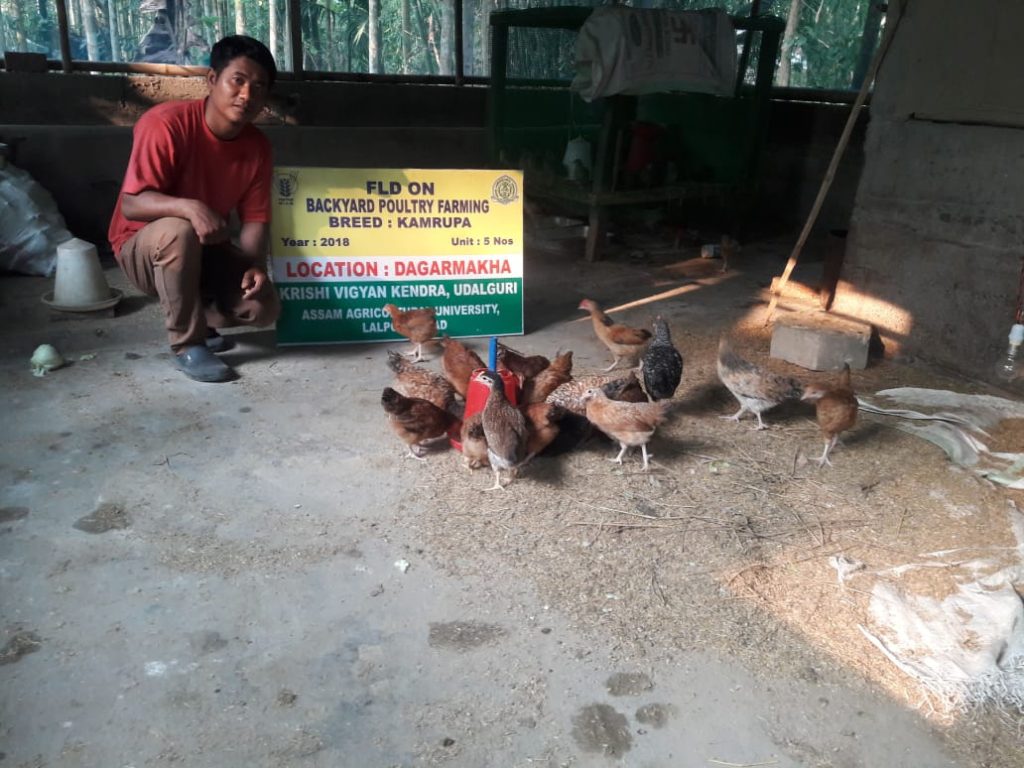
Under KVK’s continued guidance, Mr. Daimari has steadily built up his livestock and diversified into goats, rabbits and several types of poultry, while his family continues to manage the rubber, tea and rice.
Pigs
Goats and Rabbits
Poultry
Crops and Plantations
Economic Impact
Mr. Daimari earns a net profit of Rs 2,20,000 a year from agriculture and allied activities. Pig farming gives him Rs 34,000 a year. His Beetal bucks provide breeding service three times a week, and the sale of kids and wethers adds Rs 14,000. Poultry earns an average of Rs 11,000. Rubber and tea bring in Rs 45,000 and Rs 36,000, and rice Rs 80,000.
Impact of the Technology
Mr. Daimari has become a role model for the youth of Udalguri, showing that a young person can build a livelihood and become an entrepreneur instead of staying unemployed. Young people from his own and nearby villages now visit his farm to learn and adopt scientific pig farming and poultry rearing.
Conclusion
Mr. Ripu Daimari’s journey shows how timely training and demonstrations from KVK Udalguri can help a young farmer move from traditional to commercial livestock farming. By combining scientific pig rearing with goats, poultry, plantations and rice, he has built a diversified and steady income, and inspired other youths in his area to follow the same path.